
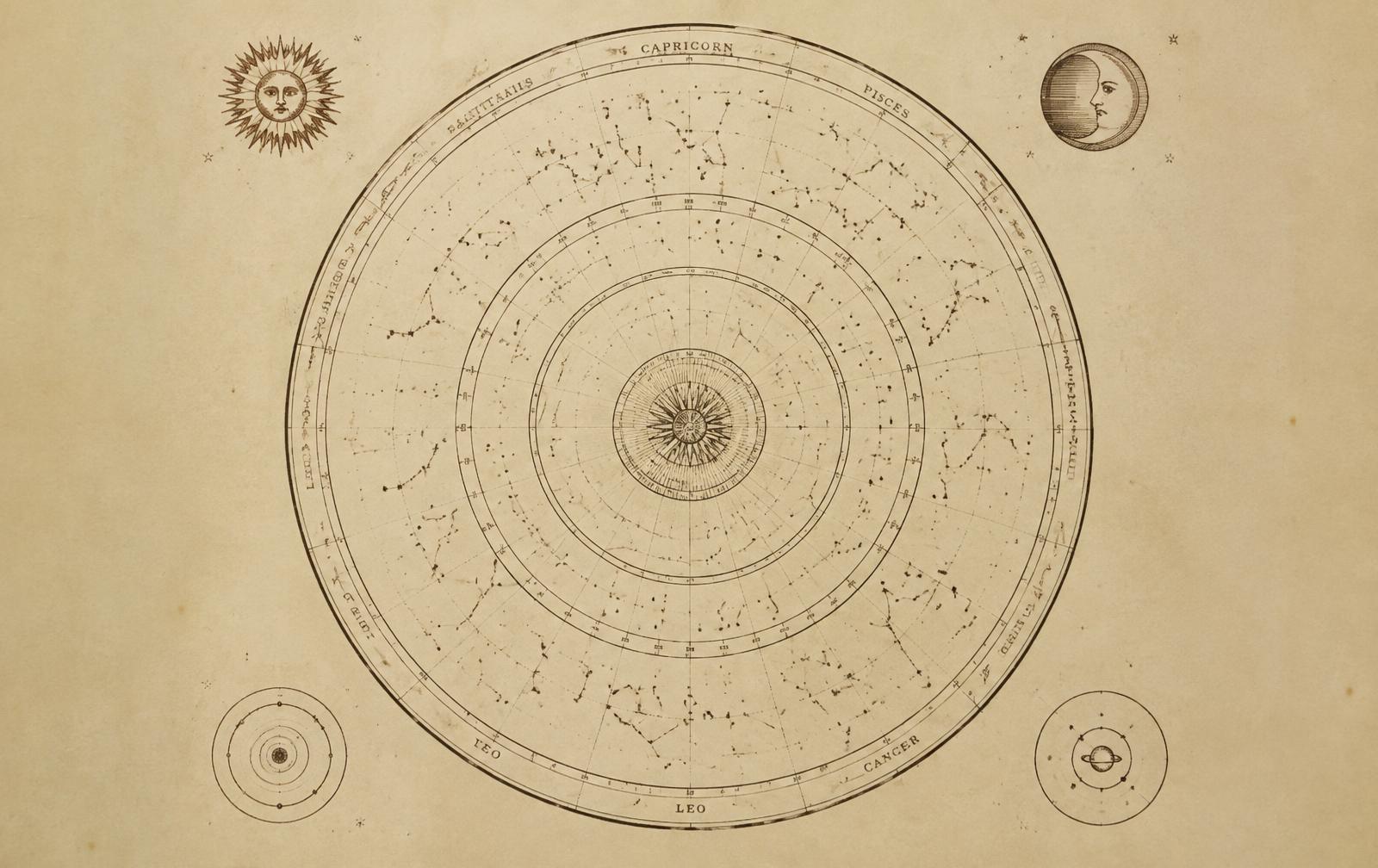
Long before the twelve signs became the familiar language of astrology, Indian sky-watchers were following the Moon. It takes roughly twenty-seven days for the Moon to travel all the way around the zodiac, and they divided that path into twenty-seven stations, one for each night. These are the nakshatras, sometimes called lunar mansions.
Each one covers thirteen degrees and twenty minutes of the sky, so every sign contains two and a quarter of them. That might sound like a technical detail, but it changes the reading enormously. Two people with the Moon in Taurus can feel quite different from one another, depending on whether it sits in Krittika, Rohini or Mrigashira.
Every nakshatra has its own ruling planet, its own presiding deity and its own symbol, and those associations carry a great deal of meaning. Ashwini, the first, belongs to the twin horsemen who are physicians to the gods, and it has a quick, restless, healing quality. Rohini, the Moon's favourite, is associated with growth, fertility and beauty. Ardra is linked to Rudra, the storm, and often describes people who go through intense upheaval and come out wiser. Revati, the last, is about safe passage and gentle endings.
When I look at a chart, one of the first things I note is the nakshatra of the Moon at birth, the janma nakshatra. It says a lot about someone's emotional nature: how they respond under pressure, what comforts them, what they instinctively reach for. I have often found it more revealing than the Moon sign on its own.
The nakshatra of the ascendant, and of any strong planets, add further layers. Sometimes a person's chart seems contradictory until you look at the nakshatras, and then suddenly it all fits.
There is also a beautiful practical link. The Moon's nakshatra at birth decides where your Vimshottari dasha sequence begins. So the same small slice of sky that describes your inner temperament also sets the rhythm of your life's timing. I have never stopped finding that elegant.
If you are new to Vedic Astrology, you do not need to learn all twenty-seven. But it is worth knowing your own. Many people tell me that reading about their nakshatra was the first time astrology felt personal rather than generic.